What is Gain in Audio? A Complete Beginner’s Guide
Jyotirmay Menon
14 Jul, 2026
Audio Fundamentals
Music Production
|
If you’ve ever sat behind a mixing console, opened a DAW for the first time, or watched a producer twist a knob before recording even started, you’ve probably wondered: what is gain, exactly? It’s one of those words that gets thrown around constantly in studios, yet very few beginners actually understand what it does or why it matters so much. This guide breaks it down in plain language, so hopefully by the end, you’ll know exactly what gain is and how to use it confidently.
What is Gain in Audio?
Simply put, gain is the amount of amplification applied to an audio signal before it enters the rest of your signal chain. When someone asks what is gain in audio, the short answer is this:It’s the initial boost given to a weak audio signal like a microphone or instrument input to bring it up to a workable operating level.
Think of gain as the front door of your entire recording process. Before EQ, compression, reverb, or any other effect touches your sound, gain has already shaped how strong or weak that signal is. Get it wrong here, and every step afterward becomes harder to fix.
To better understand what does gain mean in audio, try picturing sound as electricity. A microphone converts sound waves into a tiny electrical signal. That signal, on its own, is far too weak to be recorded or processed properly. Gain amplifies this weak signal, bringing it up to what’s called “line level” — a standard strength that recording equipment and software can work with effectively.
It’s worth noting that this is entirely different from the volume function. Volume typically adjusts the output level of a signal after it’s already been recorded or processed, like turning up your speakers or increasing your headphone level while listening to music. Gain, on the other hand, adjusts the input level, shaping the signal at its very source.
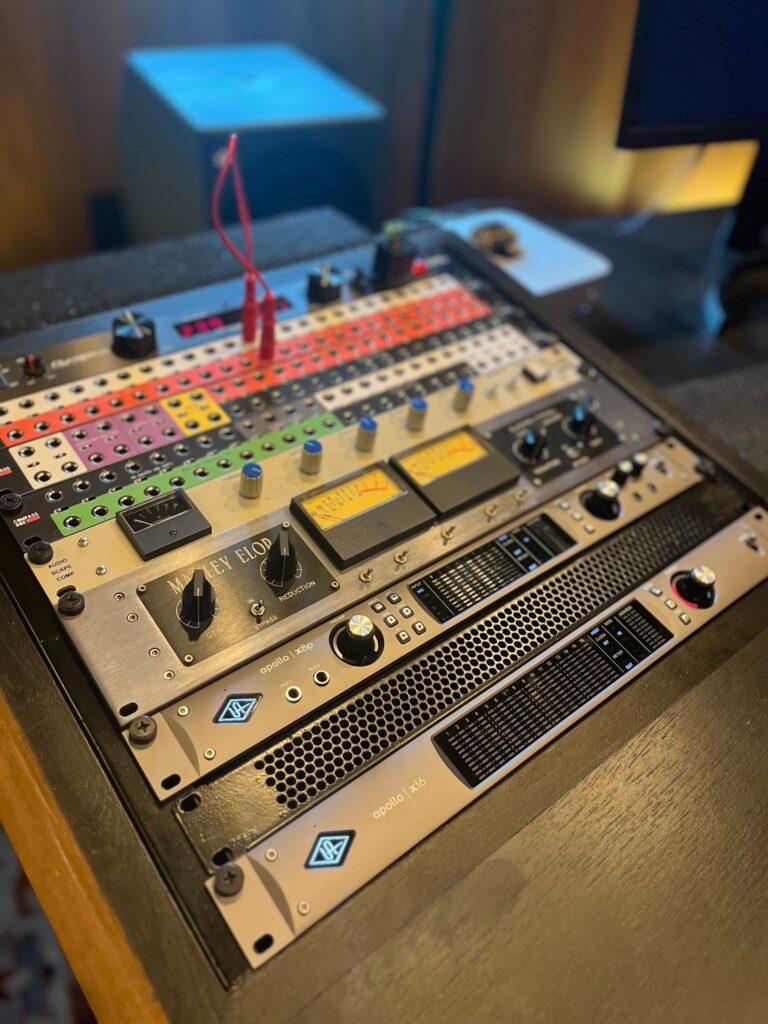
The Apollo x8p and Apollo x16 at Compass Box Studio
What Does Gain Do in Practice?
So what does gain do on a technical level? It controls how much a preamp amplifies an incoming signal. Every microphone, guitar, keyboard, or line-level instrument needs a certain amount of gain to reach an optimal recording level, loud enough to capture detail and clarity, but not so loud that it distorts.
If your gain is set too low, your recording will sound thin and quiet. If you boost such a source signal later, you’re bound to observe background hiss. Conversely, if your gain is set too high, you risk “clipping”; a harsh, distorted sound that occurs when the signal exceeds the maximum level your equipment can handle. This is why “gain staging” is considered one of the most important foundational skills for a producer or engineer.
Good gain staging means adjusting levels at every point in your signal chain, from the microphone preamp, to the mixer, to your DAW so that nothing peaks too hot or falls too quiet. It’s the base that everything else in your mix is built on.
What is Gain in Music? Why Should It Matter to Musicians?
For those wondering what is gain in music, it’s worth zooming out from technical definitions to the creative side. Gain isn’t just a dry engineering term, it directly shapes the character and emotion of a recording.
Take an electric guitar, for example. Guitarists will often deliberately push gain to create the warm crunch of an overdriven amp or the aggressive edge of heavy distortion. In this context, gain becomes a creative tool, not just a technical necessity. Genres like rock, metal, and blues rely heavily on high-gain settings to define their stylistic signature tone.
In vocal recording, however, gain plays a more subtle, technical role. Here, the goal is usually to capture a clean, balanced signal without unwanted noise or distortion, giving you the cleanest possible starting point before adding creative effects later. You will find that recording different vocalists requires different gain settings, as the quality and timbre of each vocalist varies from one another.
Our suggestion: Instead of having a default gain setting for vocals in general, work with the vocalist to best understand the nature of the song and its requirements.
This dual nature; technical necessity and creative tool, is what makes gain such a fascinating concept once you understand it properly.
Gain vs. Volume: A Quick Recap
Since this trips up so many beginners, let’s clarify it one more time. Gain adjusts the strength of a signal at its input stage, before it hits the rest of your chain. Volume adjusts the loudness of a signal after processing, typically at the output stage, like your speakers or headphones. Both matter, but they serve completely different purposes in your workflow.
How to Set Gain Properly
Here are a few practical tips for beginners:
Start low, then increase gradually. Begin with your gain knob turned down, and slowly raise it while monitoring the input level.
Watch your meters. Most interfaces and mixers have level indicators. Aim for a signal that peaks comfortably without touching the red “clipping” zone.
Leave room for dynamics. If a vocalist or instrumentalist plays quietly and loudly within the same take, account for some headroom so louder moments don’t distort.
Trust your ears, not just your eyes. Meters are helpful, but if something sounds harsh or strained, it usually needs adjusting even if the numbers look fine.
Final Thoughts
Gain might seem like a small technical detail, but it’s genuinely one of the most important foundations in audio production. Whether you’re recording vocals, mixing a track, or shaping the tone of an electric guitar, gain influences everything that happens afterward in your signal chain.
If you are ready to fast-track your workflow and transform your passion into professional-grade engineering, dive deeper with Compass Box Academy’sMixing and Mastering Course. You will learn the exact frameworks needed to master signal flow, dynamics, and advanced mixing techniques.
Now that you know what gain is, what it does, and how it differs from volume, you’re already ahead of most beginners walking into a studio for the first time. Take some time to practice gain staging on your own recordings, your mixes will thank you for it.
Once you have nailed the fundamentals, it’s time to experience what proper gain structure can truly do. Bring your tracks to life and explore the premium analog mixing options at Compass Box Studio, one of the Best Music Academy in Ahmedabad, where you can push real hardware, unlocking finesse and punch that digital plugins can only try to emulate!

 Music Production