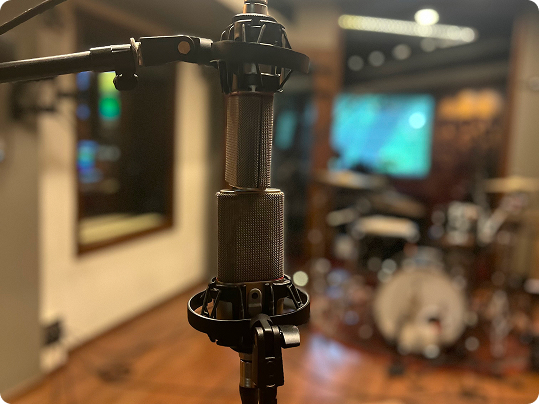
Master the technical art of sound capture. This course focuses on fundamental principles like studio recording, signal flow, microphone techniques, acoustics, and efficient session management, training you to record sound with accuracy and precision.
The Audio Engineering Program trains recording engineers in signal flow, microphone techniques, acoustics, and session management.
Master the art of capturing high-fidelity performances using professional signal chains and advanced microphone placement.
Manage the end-to-end technical recording of high-end podcast sets, ensuring perfect levels and equipment reliability.
Oversee daily operations, including patch-bay routing, session setup, and professional studio maintenance.
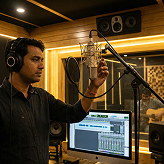
Capture high-quality field recordings and dialogue for on-location YouTube vlogs, documentaries, and corporate films.
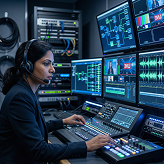
Maintain sonic integrity for live on-air transmissions, television production, and large-scale streaming events.
The 3-month Audio Engineering Course at CBA equips students with the knowledge and tools required to record sound in the cleanest, most accurate manner.
Fee payments for all the Compass Box Academy programs can be made through NEFT, IMPS, Card, UPI and cheque.
Students may use DAW of their preference but all lesson demonstrations will use Apple Logic Pro and Avid Pro Tools.
Any mid-high end Windows /Mac system that can handle audio production needs.
The fee structure for the Audio Engineering Program is ₹65,000.
For CBA students, all equipment and resources at Compass Box Studio will be available.
All classes are offline unless specified otherwise.
Students will be graded by faculties for their respective subjects with a monthly grading system.
For the capstone project, students will record a set of instruments with a session artist. They will be technically evaluated for their choice of mic technique, signal flow, and their professionalism.
Students who sign up for the 3-month Audio Engineering Course have a diverse set of opportunities post-course such as being a record engineer, assisting at a music studio, or other professions such as Recording Engineer, Broadcast Engineer and Live Sound Engineer.
Audio Engineering covers the front end of a project — recording, signal flow, mic placement, acoustics. Post-Production covers the back end — mixing and mastering the recorded material. They're designed as sequential, complementary programs rather than overlapping ones.
All classes are conducted offline at the Ahmedabad campus unless otherwise specified — there's no self-paced online track for this program.
Through a monthly grading system, with faculty assessing students subject-by-subject rather than a single final exam.
Any mid-to-high-end Windows or Mac system capable of handling audio production software — the studio doesn't mandate a specific brand, but it should comfortably run Logic Pro and/or Pro Tools.
The program doesn't publish comparative salary data, but lists Recording Engineer, Assistant/Studio Manager, Broadcast Engineer, Podcast Technical Director, and Location Sound Recordist as the direct outcomes — broadcast and live event roles typically command higher starting pay in the Indian market than studio-assistant roles, though this varies by city and employer.